
Three different rodents, three behaviors that have almost nothing in common, and a single word to describe them in everyday conversation. The owner who calls for a squirrel in the attic almost always talks about the gray squirrel. The one describing a small red animal calling from a spruce squirrel talks about a red squirrel, and that one will probably never enter his home. The third, the striped chipmunk, does not climb: it digs. The Quebec government’s wildlife records give the characteristics of each, and the difference between the three determines the system and the place to look.
The gray squirrel, the one who enters buildings

It is the species that fills our notebooks. It lives in cities as well as suburbs, adapts to mature trees on a residential street, and does not hibernate. It depends on reserves buried in its territory, which it can find by smell under about thirty centimeters of snow.
Its calving takes place from April to August, with one or two litters depending on the year and food availability. Litters consist of one to nine young, averaging two or three. In autumn, the young of the year disperse and seek territory, which explains the peak calls between September and November.
It enters through soffits, roof vents, damaged cornices, and flashing joints. The ministry recommends a metal mesh mesh of one centimeter or less to block access points, and a clearance of at least three meters between the branches and the building. These two measures resolve the majority of cases, provided they are applied after the occupants have left and not before.
Despite its name, it is not always gray. The black form, very common in Quebec, is the same species. Many owners believe they are dealing with two different animals.
One detail changes everything in the course of an intervention: the gray squirrel often sets up several shelters at once on the same territory. A leaf nest in a tree, a mezzanine, sometimes a nearby shed. Closing a single access without checking the others shifts the problem a few meters, and the owner believes it was a failure even though the animal was already using its second address. That is why our inspections cover the entire building and not just the point where the noise was heard.
Why a red squirrel rarely ends up in an attic
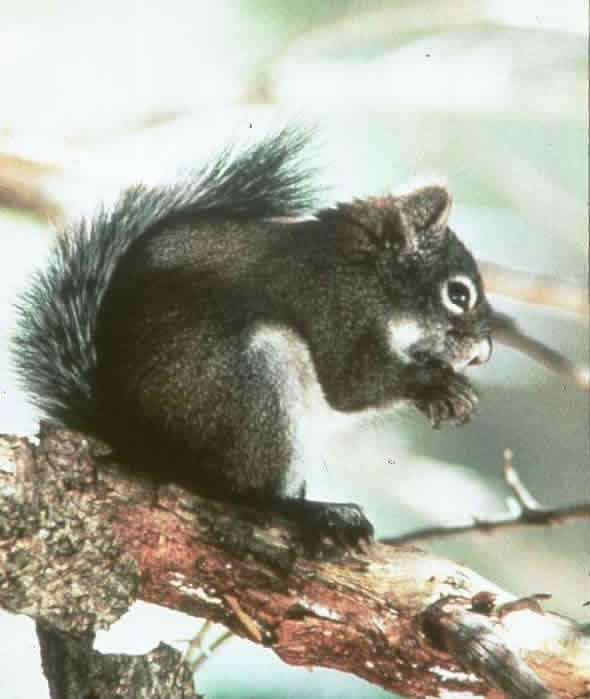
The red squirrel measures 28 to 35 centimeters in body, with a tail of 9.5 to 15 centimeters, and weighs between 140 and 250 grams. It is therefore significantly smaller than the gray squirrel.
Its coat changes with the season: red in winter, olive brown, and gray in summer, with a belly that remains white all year round. It occupies almost all of Quebec, except for certain areas of the Ungava Peninsula, and it prefers coniferous or mixed stands. Its home range covers two to eight hectares, which it loudly defends.
It produces only one litter per year, about five young, after a gestation of about forty days, with births in April and May. Its diet revolves around coniferous cones, acorns, seeds, hazelnuts, buds, and mushrooms. It also consumes swollen sap buds, especially those of maples, which makes it problematic in maple groves.
In a residential area bordered by conifers, it sometimes settles in a cottage or a shed. But in a suburb planted with maples and ashes, the attic animal is gray in almost all cases. This distinction avoids looking for a high-altitude entry point when the problem lies elsewhere.
The striped chipmunk digs, it does not climb

The striped chipmunk, which everyone calls Swiss, measures 20 to 30 centimeters in total and weighs up to 125 grams. It is immediately recognizable by its five dark dorsal stripes, one of which runs over the head, and by its short tail relative to the body.
Its life takes place on the ground. Its burrow has only one visible entrance, a gallery 45 to 85 centimeters deep, and ends with a circular chamber about fifteen centimeters thick lined with insulating materials. Some burrows reach four meters long, with connected tunnels and annex chambers.
It enters hibernation around November, but with a sleep interrupted by awakenings to consume reserves accumulated since the end of July. In October, each individual has gathered enough to spend the winter. Reproduction takes place from mid-April to mid-May, with a gestation period of about 30 days and litters of four to six young.
For a building, the issue is not the roof but the foundation, patio slabs, walls, and concrete curbs. A burrow dug under a slab eventually creates a void, and the void eventually becomes visible.
Its entrance is its signature. A clean hole about five centimeters in diameter, without a mound of earth around it, almost always against an obstacle: a low wall, a border, a step, the base of a tree. The lack of soil confuses many owners, who look for a pile like a marmot would. The chipmunk evacuates the spoil elsewhere, precisely to avoid signaling its shelter. Spotting this clean hole is the fastest diagnostic step in the entire exterior inspection.
| Criterion | Gray Squirrel | Red | Chipmunk Chipmunk |
|---|---|---|---|
| Adult weight | 400 to 700 g | 140 to 250 g | Up to 125 g |
| Distinctive sign | Large bushy tail, gray or black | White, reddish belly in winter | Five dark dorsal stripes |
| Preferred habitat | Deciduous trees, residential areas | Softwoods and mixed stands | Edges, low walls, undergrowth |
| Winter | No, active all year | No, active all year | , with periodic awakenings |
| Carried per year | One or two, April to August | One, April and May | One to two, starting mid-April |
| Enter the building | Frequently, through the roof | Rarely, cottages and sheds | Almost never, stay on the ground |
| Main damage | Soffites, insulation, wiring | Cones, buds, maple groves | Terriers under slabs and borders |
| Work window | Sept. to March, excluding calving | July to March | All year round, empty burrow |
What the species concretely changes in treatment
The device first. A trap calibrated for a 600-gram gray does not trigger properly on a 100-gram chipmunk, and a one-way device placed on a soffit is useless against an animal living under a slab. Choosing the wrong species is a waste of a visit.
Then the location. For gray, we inspect the roof, soffits, vents, and overhanging branches. For red, we look at sheds, chalets, and wooden buildings bordering conifers. For chipmunk trees, we look on the ground, along foundations, for concrete walls and stairs.
Finally, the calendar. Contrary to what is assumed, there is not a single good period for the three. The window for work on a gray squirrel opens at the end of summer and runs until March. On a chipmunk, it depends on the occupancy of the burrow, which is confirmed in a few days.
Our squirrel capture interventions always start with this identification, and our page on squirrels details the closure work. For deterrent methods, our comparison of squirrel repellents reviews what works and what is marketing.
Frequently
Asked Questions
Is the black squirrel a distinct species?
No. It is a form of the gray squirrel, very common in Quebec. The behavior and treatment are identical.
Can a chipmunk enter a basement?
Rarely, and generally through a foundation crack or window well rather than intentionally. If it’s indoors, look for an opening at ground level.
Do squirrels really chew electrical wires?
Yes, gray in particular, because it wears its incisors on anything with the right diameter. That’s the main reason why a presence in an attic doesn’t get dragged along.
Should bird feeders be removed?
At a minimum, move them more than three meters from any building or branch. A feeder attached to the wall fixes a population on site, regardless of species.
How long before a squirrel returns?
If there is one opening left, a few days. If none remain and the overhanging branches have been cut, the pressure drops for good. The site’s memory is real, but it does not cross a physical barrier.
Are populations increasing on the South Shore?
The areas developed since 2015 on the edge of woodlands concentrate calls, simply because mature trees and new buildings coexist there on a narrow strip. This is not a population explosion, it is a convergence.
Is a mosquito net enough to block a vent?
No. The incisors pass through in one night. The only material that holds is a metal mesh mesh one centimeter or less, mechanically fixed and not glued.
Identifying the species takes two minutes and determines everything else: the tool, the area to inspect, and the time to intervene. Our teams do this sorting at every call on the South Shore, from Longueuil to Saint-Basile-le-Grand, and the pest calendar places each species within the year.


